Sunday, May 29, 2011

Oliver Ranch - Part 2

Nauman's "untitled" Stair


Bruce Nauman's remarkable "Untitled" stair at the Oliver Ranch property is part of a series of works Steven Oliver commissioned for this property just a couple miles east of Geyserville.  

Despite the array of artistic talent on the site, after a few hours roaming the property, you feel there is a characteristic running through the work.  In one respect, it is quite obviously "the site."  There are few level spots.  The site, just off the valley floor of the Russian River, undulates everywhere you look.  

As an architect, I have seen different approaches to this kind of topographic challenge.  There is a strong temptation in the architecture and engineering design industry to cut and fill to create a level pad or "bench" for a project.  This is true despite the tremendous effort involved in creating a level bench where the land does not organically want to have one. Why is this so often done?  One simple answer is it makes schematic design simpler.  Not necessarily appropriate or practical, but simpler.  

Obie Bowman is a local architect who rarely caves to this instinct and crafts his buildings to respond to exisiting conditions.  A laudable instinct worthy of emulation.

In anycase, one has the sense on this property that most of the pieces were in some way, direct responses to the specific topography on which they sit and this fact generates a wonderful consciousness of the hill's beauty.  Everywhere you look, things are moving with, or responding too, the land.  

With all the lamentation that takes place about our civilization's impact on the environment and the impunity with which we, as a culture, disregard it, it is worth musing on the sensibility of this property.  How does a building sit on the land?  It is not a metaphor for our treatment of the environment.  It is the literal manifestation of our attitude toward environment.  Do we adapt our ideas to an existing condition.  Is the site a source of inspiration?  Or do we manifest preexisting ideas with impunity.


Like so many constructs in California, this stair is not necessary, in the strict sense of the word.  If one wants one can step off and walk the hill.  The stair is a playful affair.  The treads are constant and the risers vary.  In this way the stair reads as a kind of plot of the hillside; a surveyors measurement of the land.  

But walking the stair makes you acutely appreciative of the variation in the hillside.  Not just this hillside but any hillside.  As the stair comes to the road cut, the risers becomes quite steep and one is forced to take momentous steps down the hill.  The way the stair sensitively follows the terrain makes it seem somehow more fragile; like the barb wire cow fences that bob up and down across our hills.  Looking back now on the descent of that hillside I feel aware of its personality in a way a simple stroll would not have revealed.  It reminds me of a simple truth: We can understand land through a conscious dedication to nature and wilderness observation but it is more often the case that we understand land through the lens of our built environment and our habitual experiences in it.  For this reason it is important that we preserve a sensitivity to land in the creation of our built spaces.  It is too easy to become obsessed with important, but also self important, life safety concerns (e.g. handrails and guardrails) that, outside the building, are a non-issue.  A worthy challenge is to make spaces that mingle in inspirational and esthetic ways, outside of LEED certification, with our land.


Oliver Ranch - Part 1

The sundial at the Oliver Ranch is a beautiful example of a sundial that tells a succinct story.  This sundial, by artist Roger Berry, is made up of two truncated cones.  The plate steel was shaped in Los Angeles at a place capable of rolling some of the largest conic shapes in the country.  These two conic planes trace the path of the sun at the winter and summer solstice.  The slot in the center aligns with the earth's equator and tracks the sun's path at the spring and fall equinox.  Even the carpet of grass around the sculptures seems to respond to this geometry

There is a lot to say about making an esthetic out of the sun in California and even a brief study of sundials reveals all kinds of possibilities.  The word "geometry" does literally mean "earth measurement" in Greek and sundials remind of this primordial fact.  The biggest challenge can often be legibility.  There are lots of sundial desings out there but the challenge always seems the same: How do you make a sundial that is something simple enough that a passerby can comprehend  and appreciate it with, at the most, a short narrative?  I have seen lots of sundials I have not taken the time to decipher in passing by.

When I first started making inquiry into this subject I wanted to make something rigorously accurate.  This kind of precision is elusive with sundials for a number of reasons.  It begs the question:  What is time?

If time is "the accurate representation of the increments of the solar day" you can forget about any clock precisely representing that.  The elliptical orbit of the earth insures that true noon never occurs at the same time from day to day.  The effect of the earth's elliptical orbit on the sun's position in the sky is largely responsible for this and the deviations are depicted by the analemma curve.  If one can weather the mind-boggling detail of what goes into making our civilization tick, the Equation of Time is an intriguing study.

But in many respects we, as a civilization, are only marginally interested in the sun's position in the sky with respect to time.  In today's day and age, a regular abstract division of time is probably more important to us than a representation of what is literally going on with the sun.  Like our food or our information, things are becoming more processed and removed from their causal roots.

If there is one criticism of the green building movement today, it is this question of legibility.  Who among us can recite the definition of green building?  I know for a fact there aren't many.  The definition is simply too complicated and multifaceted.  Too often buildings that are rated LEED platinum often feel like sterile engineering exercises that do very little to inspire appreciation for the natural beauty of our world.  This is where the environmental movement should be more focused.  As designers it is incumbent upon us to inspire a visceral appreciation of our surroundings in a way that is at once inspiring and practical.  Winning the hearts, in addition to the minds, of citizens is truly the most significant architectural battle we culturally have to face.   There is great beauty in responding to nature but unfortunately the LEED point system does not appear to capture or express this fact.  This sundial captures this beauty wonderfully and provokes the immediate thought this world is worth protecting.

Friday, May 27, 2011

On Pivot Doors


Often a client will request a glass door that will double as both a view window and an access point.  This kind of discussion usually leads to the possibility of sidelights.  Sidelights are slender vertical windows that flank an entry door.  There are two things that can be wrong with sidelights.  First of all, they can be reminiscent of the kind of entry treatment one finds in office buildings so they don't always help establish the identity of a home.  Secondly, they aren't a very effective method for improving a view. All continuity is interrupted by the jambs of the door.

This is where pivot doors really help.  By moving the pivot point of the door in from the side where the hinges are normally mounted, we are able to "balance" the door and effectively provide another couple feet to a typical three foot entry door width.  This particular door is 5' wide.

A couple things to bear in mind with pivot doors:

1.  Think twice about a pivot door if the home is prone to chaotic traffic.  Small children and pets could get caught in the back swing of the door.  A more typical door is arguably more dangerous when you contemplate what could happen if someone is to stick their fingers where the door closes against the jamb on the hinge side of the door.  Regardless, a pivot door takes some getting use to and this "backswing" is large enough that the chances something will get caught in the backswing of the door is higher than with a traditional hinge door.

2. Weatherstripping is problematic.  Outside of California it could be a challenge to make the weather-stripping function adequately. This door used felt weatherstripping around the perimeter but at the pivot hinge itself it is next to impossible to not have some air infiltration.

3. Since the door is effectively swinging from both the inside and the outside the jamb strikes need to be applied in the field.  This particular unit only had one jamb strike on the latch side.  The jamb closer to the pivot hinge depended entirely on felt for a seal and didn't have any applied stop.

4. Anticipate your pivot hinge hardware spatial and construction requirements.  Pivot hinges are difficult in framed floors.  This particular door had a concrete stem wall extension incorporated into its lower pivot hinge to take the loads on this atypically large door.  A straightforward installation is into a concrete slab.

If these issues can be dealt with:  Use a pivot door!  They are an elegant and attractive way to celebrate an entrance.  This particular installation was accomplished by Caldwell Trouette General Contractors.

Tuesday, May 24, 2011

Folded Plate Technology at Maker Faire


"When the Paper Folds, The Mind Folds." -Jean Piaget

I've been wanting to see this technology in the sheet metal "flesh" for sometime.  Many of the more complex folded plate forms one would like to generate from computer models are actually quite tricky to implement in reality.  In architecture school, teachers say the two kinds of descriptive geometric drawings one can execute to illustrate an object are the perspective and the orthographic projection.  At the time I heard this, three dimensional computer modeling was just starting to take off.  The idea of "unwrapping" an object was becoming an intriguing way to represent an object.  Unlike other representations of a three dimensional object on a flat paper, the unwrapped object told the whole story and if you had an Xacto knife and some tape you were tempted to make the object.  If you just connected the shared edges, you would in theory, create the object.

Easier said than done.

Figure 1


It is one thing to layout the form theoretically, as shown against the green background in Figure 1 (an early study I did for a table back in the 90's), it is another to assemble it.  If you try to use a single piece of sheet metal the shape can become deformed as you approach completion.  It is also an unwieldy way to work.  Anyone who has ever done a sophisticated origami model knows this all too well.  The key to this problem is to create play in the joints and improve workability.  The model of the elephant employed a couple methods to avoid this problem.  The sheet metal was perforated at the seam locations to insure that the fold would occur right where it was intended.  Other joints were accomplished with rivets to accommodate some flexibility at the joints and presumably compensate for a certain small degree of error.  Also, the model was assembled with multiple parts to insure that workability was not impossible.

I still haven't taken a stab at a piece of furniture or a house using a CNC method but this little model of an elephant let me know that the approach is not impossible.  An exciting time to be working with that technology.

Thursday, May 19, 2011

"Make it Right"-Part 2

A couple distinctive homes in the "Make It Right" development.   Perhaps the most striking for its unique compact form, was the Morphosis FLOAT HOUSE.  Few projects in this development manage to create the  kind of impression this house does even before one knows its story.  Taking a page from building technologies developed in the Netherlands, this house is designed to lift off its moorings.  The building remains situated on the lot with guide posts that are concealed inside the building assembly when it is at rest.  The only other item worthy of mentioning is that Tom Mayne, of Morphosis, clearly had more resources to work with than many of the architects in this development.  With an in-house CNC machine and a team of people eager to be associated with a "starchitect", this project was understandably remarkable.

The FLOAT HOUSE
Another building worthy of mentioning is the Trey Trahan house situated on a corner not.  Trey Trahan is a local Baton Rouge architect. The dynamic form of the building, the large oak and the vibrant volleyball game going on in the front yard conspire to make this project a real crowd pleaser.  The economy of this building form exclusive of its snazzy front porch, makes it plausibly affordable. This is more than I can say for the FLOAT HOUSE.  

Trey Trahan House


Tuesday, May 17, 2011

"Make it Right" - Part 1

Steven and Will Playing a Set in Jackson Square
While down in New Orleans for the National AIA Convention, I had chance to talk with a couple street musicians, Will and Steven, about Hurricane Katrina. They both had construction experience and they were ready to dialogue on the fallout between sets.  Will said “After Hurricane Katrina we had Chinese Drywall.” 

He went on to explain that a lot of the chinese drywall that got shipped to New Orleans as part of the reconstruction had a highly acidic component.  According to Will it had some volcanic rock content that corroded wiring and he had an electrical fire in his house as a consequence.  I was interested in seeing what others affected by the disaster might have to say about this subject.

I took a taxi to the 9th ward from downtown.  The trip out there from downtown is only about four miles and while there had been a few stories about safety concerns, the walk back downtown in broad daylight was a serene affair.   The most disconcerting thing about the bi-water and 9th ward neighborhoods during the day is their semi-vacant quality.  This is particularly true of the 9th ward, which was on the “wrong side” of the levee. 

A Typical 9th Ward Street


There had been several models of the Brad Pitt “Make it Right” buildings at the AIA convention and I wanted to see these interesting specimens in the context of the rest of the ninth ward.  The taxi driver dropped me off on Tennesse Street, where you can find most of the MIR (“Make it Right”) buildings.  The brighter colors, extra height and abnormal geometry of these homes are the first things one notices.  The street has a unique feel and the buildings are unmistakably different than the other homes that have been rebuilt in the area. 

A grouping of "Make it Right Houses"

At the convention there had been several paid tours that would take you out to see the 9th ward one had the feeling the neighborhood had seen their fair share of architects come through on previous days.  I would characterize the atmosphere as both guarded and friendly. 

As I got to the end of one of the main streets associated with the “Make it Right “ effort I came across Robert, sitting on the vestige of a concrete stair in his front yard.  He was using this “stoop” to gut fish and he asked me if I was an architect or an architectural student.  “I recognize your black book,” he said. “All the architecture students have them.”  

Robert's House (the stoop in the foreground is from the original house)

This is always a hurdle with doing or researching affordable housing.  The people who are the subject of the project are aware they are, to some extent, “typecast” for that project.  Nobody wants to simply be the “affordable housing” person.  If its going to be like that you better be willing to be “typecast” too.  If the shoe fits you better be willing to wear it.  There was something a little pretentious about it but this didn't quell my curiosity.  We had a good laugh about it.

Robert was amazingly gracious.  His home was a metal SIP panel house similar to the Agriboard projects we have recently executed.  There were several of these in the “Make it Right” effort and Robert invited me inside to see the interior.

All the homes are surprisingly narrow simply because of the New Orleans “shot gun” lot morphology.  Robert’s house appeared to be two stories but on closer examination, the balcony on the front façade of the house was simply a means of egress.  There was not much associated with the balcony on the inside beyond a small loft.  Many people had been trapped and died in attics during the hurricane.  These balconies and attic hatches are a means of egress during such an event.  Robert showed me the spiral stair that went up to his loft/balcony and introduced me to the cat.  His daughter was sleeping so we didn’t go in that room. 

Metal SIP Panel for Robert's House


I asked Robert about the drywall and he said all the houses in the 9th ward were LEED platinum certified and the drywall was “paperless.”  As a consequence there was no issue with the chinese drywall.  Apparently the paper is a major contributor to the mold in the homes and by keeping the drywall paperless they were able to substantially mitigate mold growth.  This approach is definitely something to keep in mind for a project on the “dark side” of Fitch Mountain or out in Forestville here in Sonoma County.  The one thing to be aware of with paperless drywall is the fact the paper is there for a reason.  The paper finish associated with traditional drywall is replaced with a rougher fiberglass matt facing that requires a skim coat of drywall mud over the entire wall (i.e. level V).  This finish can be about 15% more expensive than more standard drywall finishes but under the right circumstances this is a good investment.

As Robert and I wound down our conversation Robert explained he had lost both his granddaughter and Mother in the hurricane.  About a block and half down there was a wreath on an old oak tree on the other side of the street and he explained that his house had drifted all the way down there during the storm and that was why there was a wreath on it.  As an architect, its easy to see the recovery effort as a simple matter of coming up with a clever design to repair the physical damage to the built environment.  Talking with Robert reminded me this was the tip of the iceberg.

But I have a lot of hope for the 9th ward.  The people there were so gracious and I'd dare say a little proud too.  One young girl had set up a praline cookie stand to sell cookies for $3 each to the visiting architects.  Like so many places in america their beauty is a unique amalgam of civilization and wilderness, order and spontaneous invention.

The next post will feature some of the more distinctive work associated with this endeavor.


Friday, May 13, 2011

The Glib Flip Side of All This Capacity for Patterns


Having just finished extolling the virtues of this budding era of "pattern freedom" in the previous post, I find myself thoroughly burnt out on the variety at this year's National AIA (American Institute of Architects) Convention.  All the pattern variety feels glib.  The manufacturer's clearly have the capacity to make any shape they want and boy do that want to share that with you!

Forgive me if I'm sounding like a snob, but after a couple days of exposure... I think anyone would consider themselves some kind of twisted expert on this little corner of the building product's world.  We are not talking here about the kind of sophistication that someone like Erwin Hauer brings to the subject of patterning.  Erwin makes the subject seem large and mystical.  Ironically, for all its abundance and excess, the expo makes the world of pattern possibilities seem small.

It is admittedly a cheap comparison to pit someone in the creative arts against a product expo.  Still, it underlines the blurred distinction between a raw material that can develop into something beautiful and the whistful desire on the part of the consumer - be they a developer or architect - to buy this beauty "in a can".  No assembly required.  These kinds of products always seem novel when they are still displayed as prototypes on the showroom floor.  

But we have seen this movie before.  

While the patterning capacity we have today is something new it is worth comparing historic images with images from the show today as a cautionary tale about how these patterns might age in the hearts and minds of the general public.  On the one hand you have Wright's Ennis House with tiles he had made specially for his project.  On the other hand, you have the possibility of cheesy prefabricated products that became part of our collective unconscious.  This is ultimately not the manufacturer's fault at all but rather a poverty of imagination associated with the products implementation; a history of expedient decisions.  We look at many of these images now and too often think the developer or designer just wanted to make something fancy without thinking or working very much.  In other words: without creating.

Like any technology or superhero, new patterning technologies can be used for good or evil.  I'm going to  make a mental note to try and ADD this to my tool box without throwing out something conscientious in the process.


Friday, May 6, 2011

A CNC (Computer Numerically Controlled) Castle


This is a break from the usual construction photos to talk about a subject near and dear to my heart.  There is a lot of interest in prefabrication these days in the field of architecture but, for the most part, the capability of the computer to model interesting shapes is way ahead of the industry's ability to fabricate those shapes economically and/or practically.  This is true despite the presence of "3D printers"and the like.

In college design schools there is a lot of dreaming about this potential and at Studio Ecesis there is a "tip of the iceberg"sense about our recent Agriboard projects.  It's fun to panelize a house, but the SIP panel manufacturers and the structural engineering industry aren't really capable of easily generating many of the forms that seem readily possible on the computer.

Spring is here and elementary schools and preschools are starting to call parents with requests to help out with end of the year projects.  It recalls an effort from a few years back.  When fundraising projects for my elementary and preschools boys come up, it always seems like a good opportunity to stimulate their interest in burgeoning technology while doing a little whimsical discovery as a designer.  

It can get a little out of hand sometimes.  Dad sometimes gets a little lost in front of the computer or out in the shop.

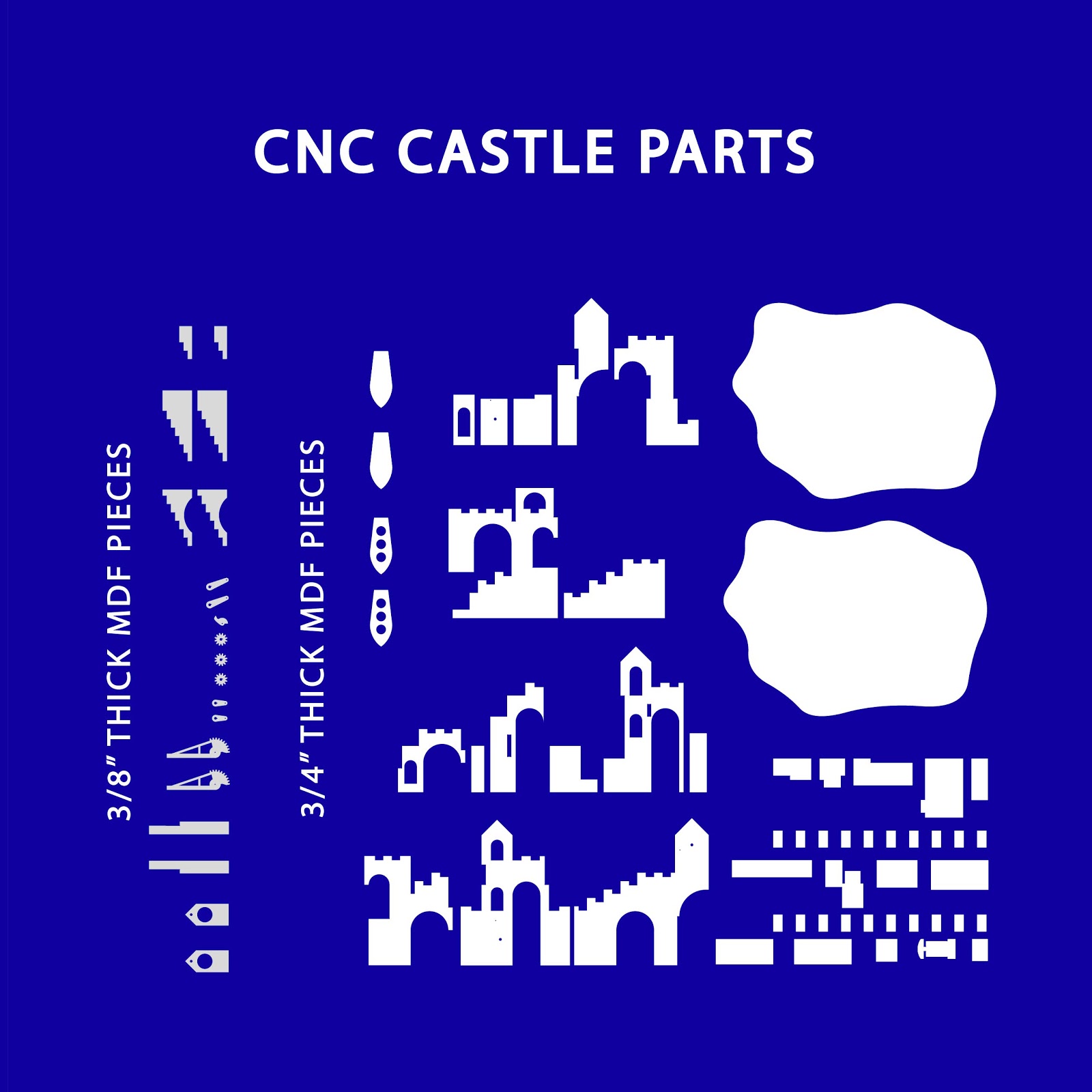
These two images are a summary of a preschool fundraising project done with the help of a couple fellow Dads (Tim Nordvedt and Mark Jankowski) a few years ago.  After doing several design sketches and some computer modeling, we went down to Santa Rosa to have the dirty work done.  I picked up some calibrated MDF down at Higgins Lumber and then went to Econoline Signs at the north end of town.  We put the MDF on their milling table and let the CNC (Computer Numerically Controlled) milling machine do the cutting.  There was a lot of cutting.

If memory serves, this piece auctioned for $900.  We spent about $300 on materials so we breathed a sigh of relief when the bidding climbed past that.  Nereo Woodturning in Windsor was kind  enough to turn enough wood "people" for each kid in the class to draw a face on each piece.  The whole thing was a lot of fun to assemble and witness the kids discover.  I'd encourage anybody else looking for a cool fundraising angle for their school to check out this technology.  If you can model it with planes of a consistent thickness, chances are it can be built pretty economically and assembled practically.